How to Take a Competitor’s YouTube Title Apart and Find the Phrase Doing the Work
For a long stretch I studied successful videos the way most people do. I looked at the thumbnail. I looked at the editing. I watched the whole thing twice and pulled up the retention curve in my head. I took notes on pacing.
My own numbers barely moved.
What eventually changed things was the one element I had been skimming past every time: the title. Not reading the title — anyone can read a title. Taking it apart.
Nine years of building faceless channels for English-speaking audiences later, a title teardown is still the first thing I do when I want to understand why a competitor’s video is working. It is unglamorous, it takes about twenty minutes, and it answers a question watching the video never will: which words in that line are carrying the demand?
What a Title Teardown Actually Is
You take the title of a video that is doing well and stop treating it as one sentence. You break it into every short phrase inside it, and then you measure the phrases individually.
The premise is that a title is not one keyword. It is a stack of them, and usually only one or two are doing real work. The rest are grammar. YouTube keyword research that stops at the whole title tells you almost nothing, because nobody searches a whole title.
Step One: Pick the Right Video
Do not tear apart the first thing you see. A one-off viral hit is the worst possible teaching material, because whatever happened to it probably will not happen again and you cannot tell which part was luck.
Pick videos that meet all three of these:
- It is still gaining views now, not a spike from eighteen months ago
- It sits clearly inside the niche you are actually working in
- The channel has more than one video like it, which suggests a repeatable format rather than a fluke
A video that keeps collecting views over months is being found on purpose. That is the kind you want to reverse-engineer.
Step Two: Break the Title Into Phrases
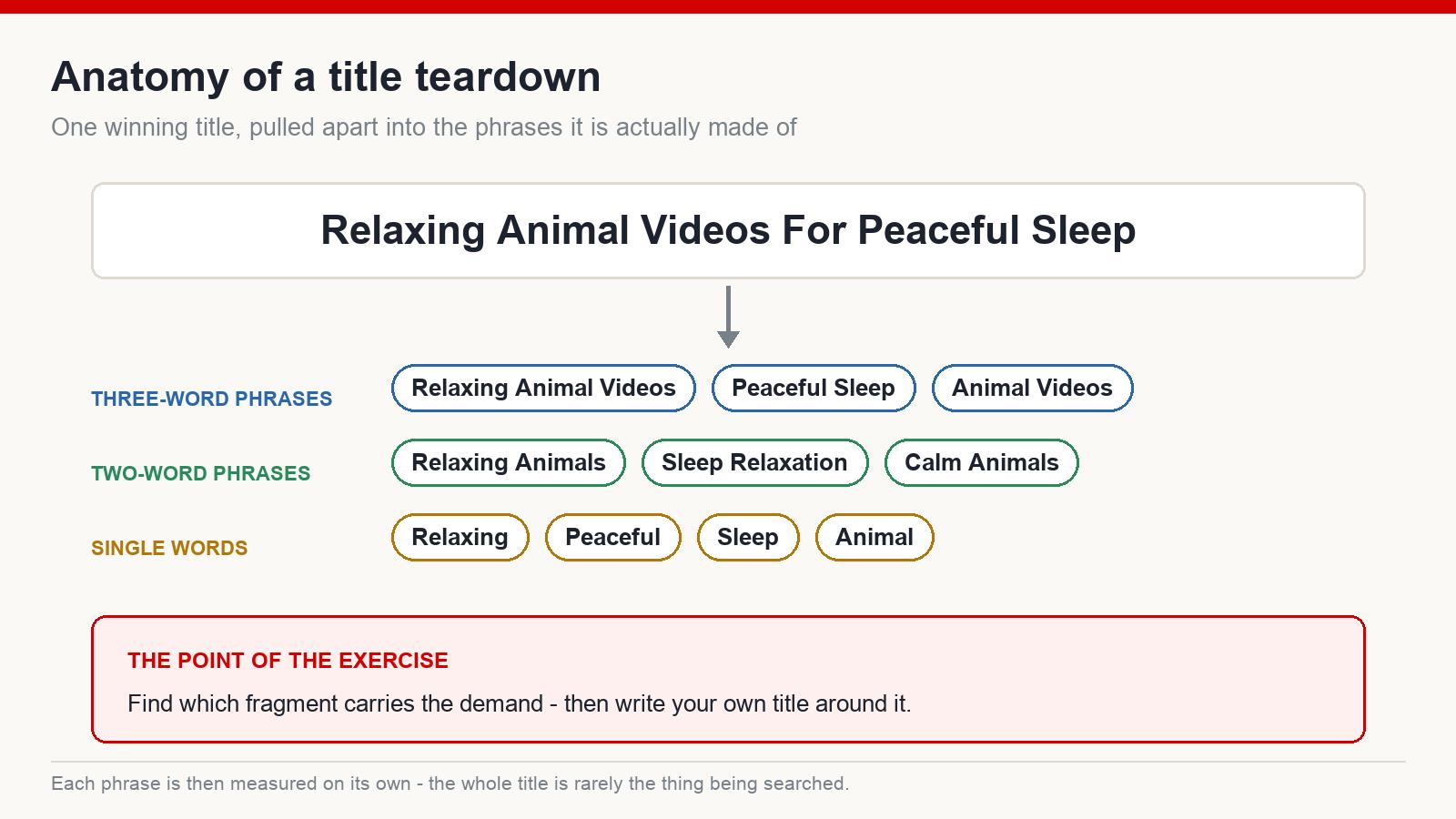
Take a title like Relaxing Animal Videos For Peaceful Sleep. It sounds simple, and it contains several distinct searches.
Pull out every phrase that could stand on its own, working down from long to short:
- Three-word phrases — Relaxing Animal Videos, Peaceful Sleep, Animal Videos
- Two-word phrases — Relaxing Animals, Sleep Relaxation, Calm Animals
- Single words — Relaxing, Peaceful, Sleep, Animal
Include obvious neighbours the title implies but does not say — relaxing sleep, sleep sounds — because you are mapping a demand area, not transcribing a sentence.
An AI assistant is genuinely useful here for generating the variations quickly and grouping them by intent. It is doing clerical work, not judgement, and that is the right use for it.
Step Three: Measure the Phrases, Not the Title
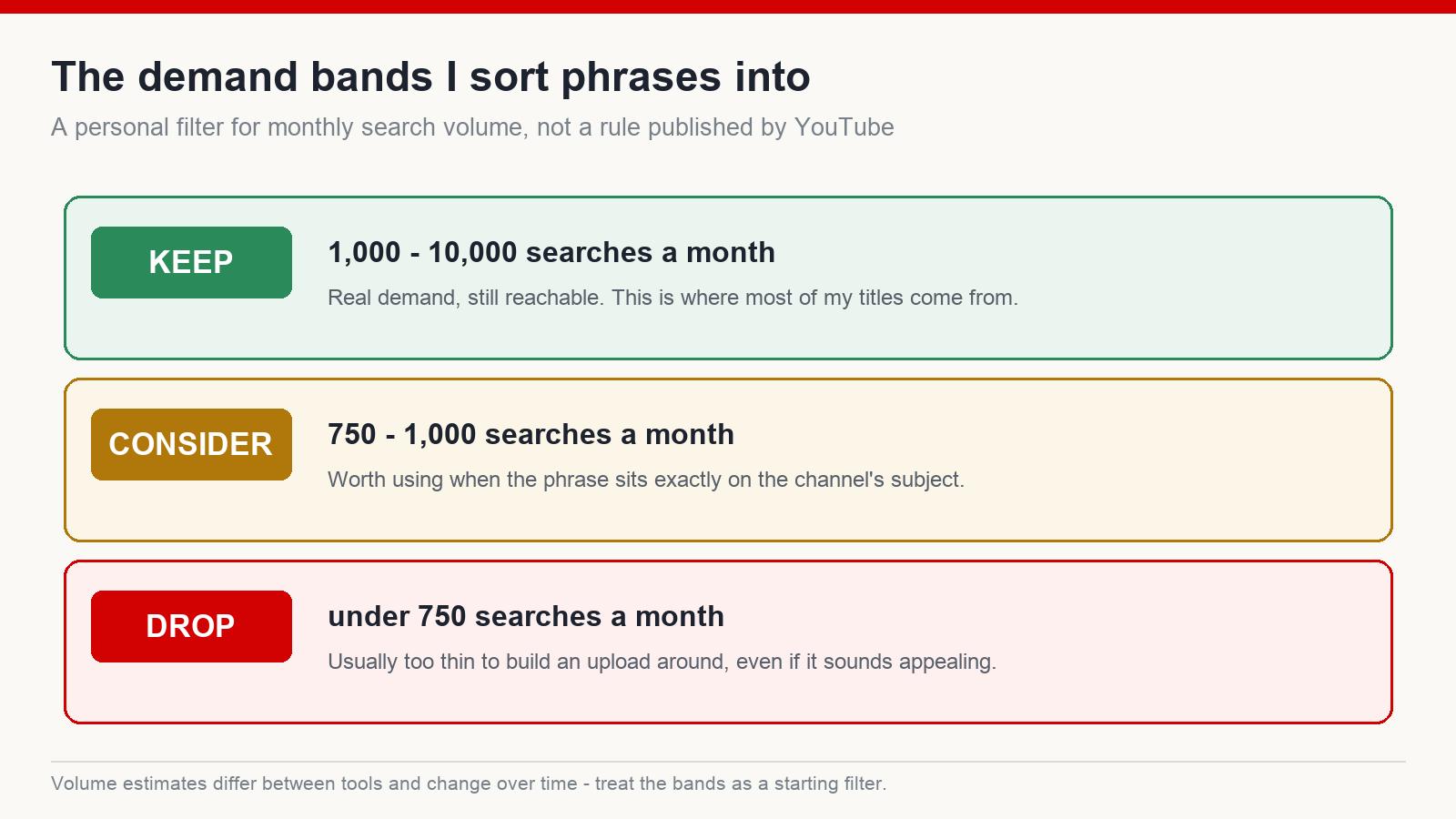
Now run each phrase through a keyword tool — vidIQ, TubeBuddy, Ahrefs, Google Keyword Planner, whichever you already use — and sort the results.
What follows is my own working filter, not a rule published by anyone. It is where I have landed after years of doing this, and you should expect to adjust it for your niche:
- Keep — roughly 1,000 to 10,000 searches a month. Real demand, still reachable, not yet dominated. Most of my titles come out of this band.
- Consider — roughly 750 to 1,000. Worth using when the phrase sits exactly on the channel’s subject and competition is thin.
- Drop — under 750. Usually too thin to build an upload around, however appealing it sounds.
Two caveats that matter more than the numbers. Volume estimates differ between tools and drift over time, so treat any figure as a rough signal rather than a measurement. And volume alone decides nothing — a phrase with strong demand and brutal competition is worse than a smaller one you can realistically win.
Step Four: Expand the Phrase That Survives
When a phrase clears the filter, do not go straight to writing a title. Paste it back into YouTube search and read the first page carefully.
You are looking for three things: which videos rank for it, which channels keep appearing, and — the interesting one — how many different niches show up.
Search something like peaceful sleep and the results will not be one category. You will see animal footage, rain sounds, sleep music, landscape films, meditation. Five niches competing for one phrase.
That tells you something a volume number cannot. The phrase is not describing a subject. It is describing an outcome people want, and several kinds of video are competing to deliver it. Which means your route into that demand does not have to look like anyone else’s.
Step Five: Use the Phrase in More Than One Place
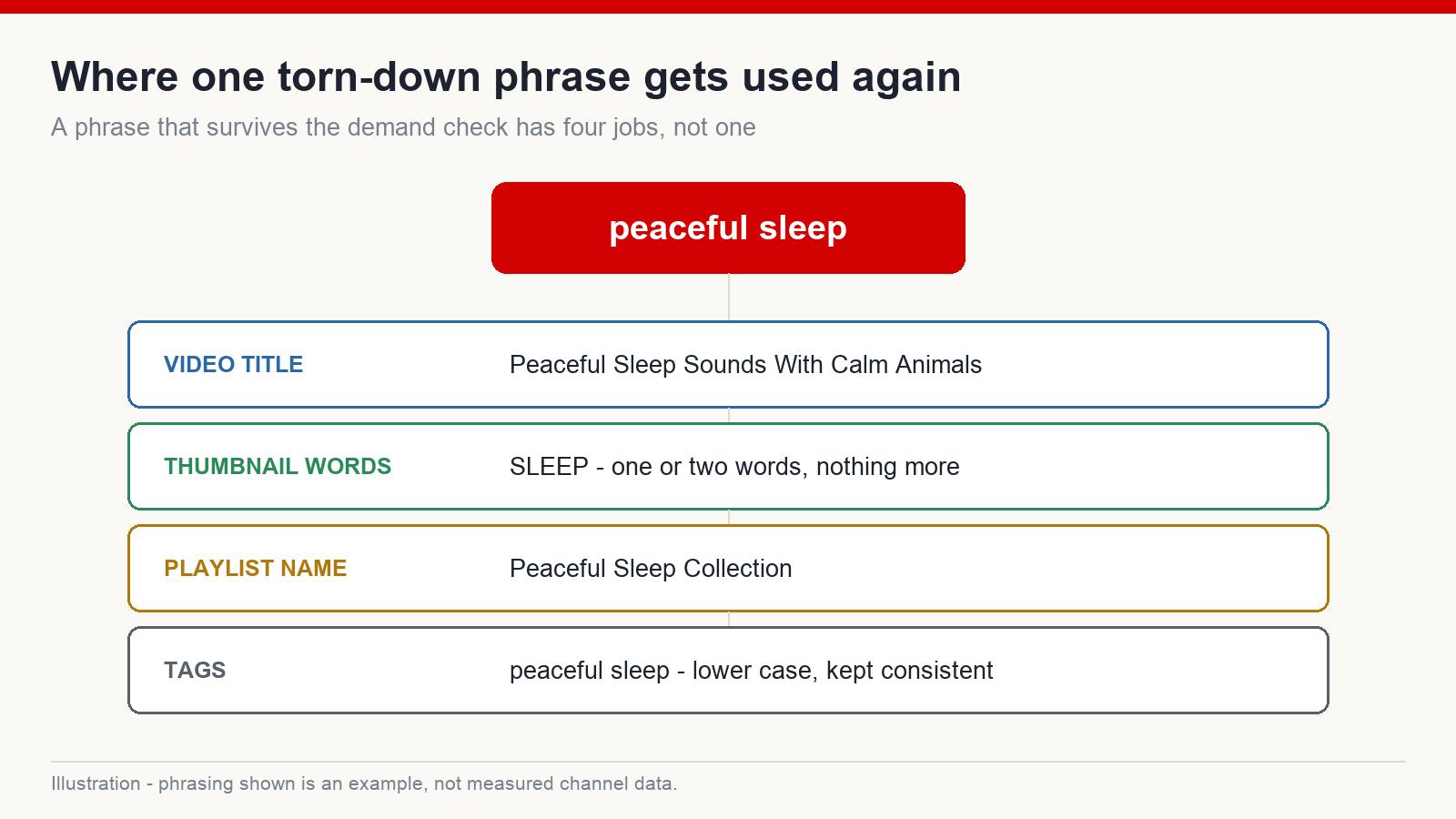
A phrase that survived the demand check has earned four jobs, not one. Most creators use it in the title and stop, which wastes most of the research.
- Video title — the phrase built into a natural sentence, not bolted on: Peaceful Sleep Sounds With Calm Animals.
- Thumbnail words — the shortest usable fragment. One or two words. SLEEP. Anything longer will not be read at feed size.
- Playlist name — Peaceful Sleep Collection, so a viewer who arrived through that phrase is offered more of the same thing immediately.
- Tags — plain and lower case, kept identical across every video in the cluster.
Used across all four, one phrase stops being a keyword and becomes the spine of a content cluster. That is where the compounding comes from, and it is the part that separates this from ordinary keyword hunting.
Three Ways People Get This Wrong
Reading volume as the whole answer
A high number is an invitation, not a verdict. Before committing you still need to know how hard the competition is, whether you can produce that content well and repeatedly, and whether it fits what the channel already is.
Copying the title instead of understanding it
The point is not to publish a near-copy of someone’s line. It is to see the structure underneath: which fragment carries the demand, which one carries the feeling, and how they were assembled. Take the reasoning and write your own.
Treating the phrase as a string of characters
This is the expensive one. A creator finds peaceful sleep, notes it as a keyword, and moves on. But peaceful sleep is not a topic. It is a state someone wants to be in at eleven at night. The creators who notice that difference build far stronger content systems than the ones who just collect phrases.
The Twenty-Minute Version
Next time a video in your niche is clearly outperforming yours, resist the urge to study the edit. Copy the title instead and run the sequence:
- Confirm the video is a repeatable win, not a one-off spike
- Break the title into every phrase inside it
- Measure the phrases separately and cut the thin ones
- Search the survivors on YouTube and read who else is competing for them
- Build the winner into your title, thumbnail, playlist and tags together
Results vary and search demand shifts, so treat every teardown as a snapshot rather than a permanent map. But very often the thing driving a competitor’s video is not the footage or the edit at all. It is one small phrase sitting inside a title that everyone else read straight past.
Which niches does a title teardown work in?
Nearly all of them. The method is about how people search, not what they watch, so it transfers across faceless channels, health, animals, education, technology and entertainment alike.
What search volume should I look for?
The 1,000 to 10,000 band is where I start, but treat that as my filter rather than a standard. Tools disagree with each other, and a smaller phrase with weak competition can easily beat a larger one you cannot rank for.
Are phrases under 750 searches ever worth using?
Sometimes — when the phrase sits precisely on your subject and almost nobody is targeting it. Just do not build a publishing plan on that band alone.
Can I use a torn-down phrase as my title directly?
Yes, provided real demand exists behind it and your video genuinely delivers what it promises. Rewrite it into a natural sentence rather than pasting the raw phrase in.
If you want to see this run as part of a whole workflow — niche selection, keyword mapping and packaging for a faceless channel aimed at an English-speaking audience — that is what I work through at mmoyoutube.com.